Showing posts with label Jaguar. Show all posts
Sunday, April 3, 2011
2012 Jaguar XF 2.2 Diesel
Jaguar has unveiled its most efficient engine yet in the form of a new 2.2-litre diesel unit.
Developing 190 PS and 332 lbs ft of torque, the new engine is capable of returning 52.3 mpg on the combined cycle while emitting 149 g/km of CO2.
Making its debut on UK roads fitted to a prototype development vehicle, the new four-cylinder 16-valve common rail diesel engine displaces 2,179 cc and is installed in a north-south configuration for the first time. The new engine features a water-cooled turbocharger with low-friction pistons, new injectors and a new crankshaft. The new configuration allowed Jaguar engineers to add a new oil pan and new electronic systems affecting the crankshaft to allow the new intelligent Stop-Start system to operate more efficiently.
Intelligent Stop-Start aims to reduce the prolonged time spent in the shutdown and start-up phase usually experienced in such systems. The Jaguar system overcomes this partly through the inclusion of the new crankshaft sensor and fuel rail pressure holding system meaning the engine needs less time to restore drive through an innovative engine restart capability. This is best demonstrated when approaching a busy roundabout – in situations where the driver briefly brings the vehicle to a stop only to move off again quickly. In conventional systems the engine needs to shutdown completely before restarting again, leading to often frustrating delays. The Jaguar system is able to restart the engine while it's shifting down from as little as 400 rpm meaning it does not need to come to a stop – drive is therefore restored more efficiently.
The inclusion of the Stop-Start function is estimated to increase overall fuel efficiency between five and seven per cent.
Along with a new engine, the development vehicle debuts an advanced eight-speed ZF automatic gearbox. With the seventh and eight ratios effectively acting as overdrive gears, the new gearbox allows the 2.2-litre engine to be optimised to deliver swift responses when required and effortless motorway cruising ability to ensure the ideal balance between efficiency and performance. The sprint to 62 mph takes 8.5 seconds before achieving a maximum speed of 140 mph.
The high levels of refinement expected of modern Jaguars are retained with engineers putting particular emphasis on sound deadening around the engine and bulkhead as well as active engine mounts to reduce vibration. The result is a 3dB reduction in cabin noise to make the car one of the most refined vehicles in its class.
The new powertrain will feature in a future Jaguar XF production car with specifications and an estimated on-sale date being announced at the New York Auto Show.
Labels:
Jaguar,
Wallpapers and Information
Monday, March 28, 2011
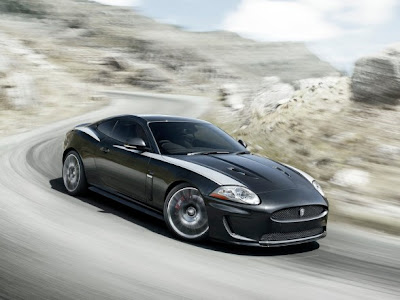
2012 Jaguar XKR-S
At A Glance
1. The most powerful and fastest series production sports car Jaguar has ever built with a top speed of 300kph.
2. Heads the XK range with an expected on-the-road price of £97,000 when ordering opens in September.
3. The ultimate expression of Jaguar's sports car strategy; offering intelligent performance with everyday driveability.
4. Uprated supercharged AJ-V8 Gen III R direct-injection engine produces 550PS and 680Nm of torque.
5. Maximum speed raised to 186mph (300kph) with 0-60mph reached in just 4.2 seconds.
6. The only car in its class to emit less than 300g/km of CO2.
7. Active sports exhaust delivers an authentic, race-car inspired soundtrack.
8. Exploits the XK's strong, lightweight advanced aluminium body architecture to maximise performance, agility and economy.
9. Bespoke suspension changes front and rear for ultimate precision, control and driver appeal.
10. Unique styling changes incorporate Computational Fluid Dynamics calculations in order to reduce lift and maximise aerodynamic stability.
11. Revised interior features 16-way adjustable memory sports seats with carbon-fibre effect leather.
12. Reprogrammed Adaptive Dynamics allow the enthusiastic driver to explore the outer edges of the handling envelope.
13. Jaguar's performance flagship competes in the sub-exotic segment, new territory for the company.
Introduction
The XKR-S is not merely the quickest Jaguar ever but also the most agile, responsive and driver-focused. The pinnacle of the XK range builds on feedback gathered from the supercharged XKR and has been developed to extend the performance parameters of the car. This new harder-edged character allows the enthusiastic driver to explore the outer limits of the car's dynamics without losing the refinement and usability for which Jaguar is famous. The structural integrity of the lightweight aluminium platform allowed the suspension to be reworked with bespoke components for increased stiffness without a commensurate loss in either refinement or Jaguar's legendary ride comfort. A reworked aluminium front suspension knuckle and revised rear geometry are allied to stiffer springs and dampers, lightweight forged alloy wheels and recalibrated steering effort to minimise any response delays and produce a more connected and agile driving experience.
The performance of the XKR-S is reflected in both its interior and exterior styling, which feature exclusive new paint colours that reflect Jaguar's racing heritage. As with competition Jaguars of the past, the exterior of the XKR-S adheres to the principle of form following function. In addition to the styling changes and in order for it to achieve 300kph, the XKR-S was the subject of extensive Computational Fluid Dynamics development work. The resulting changes reduced front and rear lift by more than a quarter and optimised lateral aerodynamic stability.
The performance intent of the XKR-S is clear from the moment the driver enters the cabin thanks to new cosseting Performance seats with prominent shoulder wings for close support during hard cornering. The seats feature 16-way adjustment, memory and heating functions while a new three-spoke steering wheel provides the perfect interface between car and driver.
Styling
* Unique, new front-end design with twin nacelles, side intakes and carbon-fibre splitter.
* Extended side sills emphasising the 10mm lower ride height.
* New rear apron incorporating a carbon-fibre diffuser.
* Unique to the XKR-S is a rear wing with carbon-fibre centre section.
Ian Callum, Design Director, Jaguar Cars: "The styling of this car isn't about image, it's about true performance. Like other iconic Jaguars before it, the styling has been driven by geometry and aerodynamics for genuine design purity. The physics required to achieve 300kph have led the aesthetic; if you don't like the way it looks, you probably won't like the way it drives either."
The first Jaguar designed entirely under the aegis of Design Director Ian Callum, the XK has received awards worldwide for its elegant appearance. Now further styling changes keep the XKR-S at the forefront of modern sports car design. Slimmer, LED headlights, more compact main air intake and vertical side power vent all contribute to a more purposeful front-end appearance. At the rear of the car the famous Jaguar 'Leaper' now takes pride of place in the centre of the bootlid.
The XKR-S also required aerodynamic modifications to achieve its 300kph top speed in the unruffled manner expected of a Jaguar and has been designed solely with an eye for purity of line and singularity of purpose. As the XKR-S approaches its top speed, there is a requirement to channel air cleanly over, around and under the car in order to maintain stability and ensure balanced downforce front and rear. An overall reduction in lift of 26 per cent has been achieved.
The necessary revisions were made after extensive Computational Fluid Dynamics work, proven through wind tunnel testing and are unique to this flagship of the XK range. The most dramatic changes have been applied to the front of the car, radically altering its appearance and lending it a more assertive look. A new bumper design features near vertical feature lines running down from the edges of the oval air intake and supporting the new carbon-fibre splitter and lower spoiler. At the extreme edges of the front fenders, vertical slots channel air down the sides of the car and along the wider sills for increased high-speed directional stability.
In order to balance front and rear lift, the XKR-S features a separate rear wing, a first for the XK range. This addition, with its carbon-fibre centre section, works in concert with the similarly constructed Venturi structure underneath the rear bumper.
The assertive new appearance of the XKR-S is subtly highlighted by some carefully chosen details exclusive to this model. Exterior trim is finished in gloss black, complemented by 20-inch Vulcan lightweight forged alloys in a dark technical finish.
The XKR-S is available in a range of five paint colours, two of which evoke Jaguar's competition heritage: Italian Racing Red and French Racing Blue.
Like the lining of a bespoke suit, the finishing touch is provided by the brake calipers, available in either red or gunmetal and emblazoned with the 'Jaguar' name.
Performance/Powertrain
* Third generation of the award-winning AJ-V8 all-aluminium powerplant with twin-vortex Roots-type supercharger.
* Revising the fuelling map boosts power and torque to 550PS and 680Nm.
* Spray-guided direct injection delivers precisely measured quantities of fuel into the cylinder heads at 150bar.
* Variable timing system on all four camshafts features actuation rates of more than 150 degrees per second.
Russ Varney, Chief Programme Engineer, XK: "With the XKR-S we have exploited the inherent capabilities of the aluminium architecture to its fullest extent to create a track-capable performance derivative extending all car's attributes and delivering an irresistible 'smile of satisfaction' response from the driver."
Astonishing engines have always formed the strongly beating heart of Jaguar's road and race cars from the record-setting straight-six in the XK120 to the smooth V12 that made the XJ12 the fastest four-door in the world when it was launched.
The AJ-V8 joined this illustrious list from the moment the first one was fired into life but in the XKR-S it is presented in its most potent form to date. Now in its third generation and with the addition of supercharging, the all-aluminium quad-cam powerplant delivers not only extreme performance but also tremendous efficiency thanks to the technologies incorporated into it, including spray-guided direct injection (SGDI) and dual independent variable cam timing (DIVCT).
Fuel is delivered directly to the centre of the combustion chambers at a pressure of up to 150bar by the centrally-mounted six-hole spray-guided injection system in order to maximise fuel-air mixing and improve responsiveness, particularly at low speeds. It has also allowed an increase in compression ratio from 9.1:1 to 9.5:1 to improve fuel economy while multiple injections reduce the warm up phase to increase catalyst efficiency and reduce emissions.
Each of the four camshafts features a variable timing system which rather than being controlled by oil pressure, are activated by the positive and negative torques generated by the movement of the intake and outlet valves, allowing for a smaller, more efficient oil pump to be fitted, further reducing fuel consumption. The VCT units respond up to three times faster than previously with actuation rates of more than 150 degrees per second at every point in the speed range, making this the most responsive engine Jaguar has ever built, with no gaps in its power delivery.
Like the car itself, the AJ-V8 features aluminium architecture with the high pressure die-cast lightweight block augmented by cast iron liners and cross-bolted main bearing caps which contribute to refinement to match its power. The four-valve cylinder heads are now constructed from recycled aluminium to reduce the environmental impact of engine manufacture.
Nestling in the 'V' of the cylinders is the Roots-type twin vortex supercharger and its two intercoolers that help provide the XKR-S with such urgent motive power. This sixth-generation forced induction unit is 20 per cent more thermodynamically efficient than its predecessor, while the intercoolers feature their own water-cooling circuit to reduce the temperature of the pressurised air to optimise power and efficiency.
The surfeit of power produced by this system meant that it was a relatively simple matter to liberate an extra 40PS and 55Nm over the standard XKR. Remapping the engine's fuelling characteristics and increasing exhaust gas flow through the use of an active exhaust system has lifted total output of the 5.0-litre V8 is now 550PS and 680Nm, making it the most powerful Jaguar road engine ever made and allowing the XKR-S to hit 60mph in 4.2 seconds and breach the magical 300kph barrier with ease.
The Performance active exhaust system that helps provide such spirited performance also produces a thrilling motorsport-inspired soundtrack to aurally reward the enthusiastic driver.
Handling
* Incredibly light and rigid with a kerb weight of 1753kg and torsional stiffness of 28,400N per degree
* New aluminium front knuckle increases stiffness by 0.13 Deg/kN
* Front and rear spring rates increased by 28 per cent
* New 20" Vulcan wheels and Pirelli P-Zero tyres reduce unsprung mass by 4.8kg
* Rewritten stability control software optimises the system for enthusiastic driving
* Jaguar High Performance Braking System fitted as standard
Mike Cross, Chief Engineer, Vehicle Integrity: "This car encompasses everything a performance Jaguar should be; as capable, precise and thrilling on a wet Welsh B-road as it is at the Nürburgring. Every response delay has been minimised in order to give the car a more connected feel in the manner in which it steers, handles, stops and goes."
Jaguar pioneered the use of aluminium construction for series production cars, exploiting the metal's low mass and high tensile strength to maximise benefits in terms of performance, agility, fuel consumption and emissions.
The platform underpinning the XK range makes the car one of the lightest and most rigid in its class with a kerb weight of 1753kg and torsional stiffness of 28,400 Newtons per degree. This fundamental strength allowed Jaguar's Vehicle Integrity team, led by Mike Cross, to develop the dynamic attributes of the XKR-S to the full, without affecting refinement. Every Jaguar achieves an unrivalled mix of sporting appeal and luxurious comfort and the XKR-S is the most driver focused Jaguar ever made.
Taking the solid foundation of the aluminium architecture as a starting point, both front and rear suspension systems have been upgraded. The double wishbone front suspension has been comprehensively revised with a new aluminium steering knuckle that significantly increases camber and castor stiffness by 0.13 degrees per Kilonewton to transform the accuracy and weighting of the steering for greater levels of connection, feedback and precision. The Active Differential Control has been reprogrammed to reduce steering sensitivity at the very high speeds of which the car is capable, increasing stability and driver control.
Rear suspension geometry has been revised with rear wheel steer optimised for maximum agility while spring rates have been increased at both ends of the car by 28 per cent. Bespoke software for Jaguar's Adaptive Damping has been written for the XKR-S, ensuring both total body control and maximum traction and grip.
Wheel sizes have been increased with the unique lightweight forged Vulcan 20-inch alloys now having a width of nine inches at the front and 10.5-inches at the rear for greater precision and grip. The new wheels wear Pirelli P Zero tyres measuring 255/35 R20 at the front, 295/35 R20 at the rear. This combination has reduced overall unsprung mass by 4.8kg with a commensurate improvement in handling and dynamism.
The Dynamic Stability Control System has been reworked to maximise the benefit of these wider tyres. In Trac DSC mode this utilises specific traction, stability and eDiff settings to alter slip thresholds, differential torque distribution and intervention levels to allow the experienced driver to explore the outer edges of the performance and handling envelope.
The XKR-S is equipped as standard with Jaguar's High Performance Braking System. Lighter and more powerful, this features cast iron and part aluminium monobloc calipers for a combination of power, stability and feel. The brake discs – measuring 380mm at the front and 376mm at the rear – are internally ventilated to provide repeated, fade-free stopping power. In combination with pad surface increases of 44 per cent front and 31 per cent rear the system provides total security and confidence on both road and track. Stopping distance from 124mph has been improved by 2.7 per cent over the already impressive XKR.
The end result is a car that captures the essential duality that is a characteristic of every great Jaguar; capable of transporting the driver to the fabled Nürburgring in total comfort and hushed silence, and yet still able to deliver a sub-eight minute lap time and then return home with total ease.
Interior
The cabin of any Jaguar is always a uniquely special place in which to spend time and the XKR-S meets all expectations from the moment the driver enters to be greeted by the red Start button pulsing like a heartbeat. When pressed, the engine fires with an rich, deep reverberation and the Jaguar Drive Selector rises from the centre console as a point of first contact to begin the process of bonding man with machine.
The interior of the XKR-S has been subtly refreshed with a host of new trim materials including ebony soft-feel paint for the switches and gloss black finish to the centre console. The model will also be exclusively available with a Dark Linear Aluminium finish as an option to the wood veneers.
A new leather-wrapped, multi-function steering wheel has also been added, providing a beautiful, tactile interface between car and driver as do the bright, Jaguar-embossed, stainless steel pedals.
Exclusive to the XKR-S are the new Performance front seats with an integrated head restraints and increased lateral and squab support to hold driver and passenger securely and comfortably in place during the high speed cornering of which this car is capable. The 16-way adjustment of squab, cushion, lumbar and bolster elements is supplemented by memory and heating functions.
The sense of occasion offered when driving the XKR-S will be heightened by the new carbon leather accents covering the seats, featuring unique contrast micro-piping and stitching combinations in Reims Blue, Red and Ivory. Duotone combinations of Charcoal with Tan and Charcoal with Red are also available.
Labels:
Jaguar,
Wallpapers and Information
Friday, March 18, 2011
2010 Jaguar C-X75 Concept
Here's another feather for Jay Leno's cap. The Tonight Show host can officially say that he is one of only a handful of drivers to have slipped their way behind the wheel of the amazing Jaguar C-X75 concept from this year's Paris Motor Show. Penned by design guru Ian Callum, the supercar is as sexy as it is advanced. The vehicle gets its power from a quartet of electric motors that are good for 195 horsepower each. Throw in two small turbine engines for generating power and you've got one very unconventional extended-range hybrid.
The C-X75 was designed to celebrate the Leaping Cat's diamond anniversary, and as such, the company pulled all the stops. With a design that pulls from the most successful points in Jaguar history, the car is nothing short of gorgeous. Will it make it to production? We're not sure, but for the moment, you can hit the jump to watch Leno take it all in – and don't forget to watch for an appearance by Callum, too.
Labels:
Jaguar,
Wallpapers and Information
Thursday, March 17, 2011
2011 Jaguar XKR Black Pack
Jaguar will unveil the latest dramatic evolution of its supercharged XKR coupe at the Geneva Motor Show in March. This XKR delivers a significantly raised maximum speed – up to 174mph from 155mph – and bold styling changes that create an evocative and unique supercharged Jaguar.
The XKR Coupe unveiled at Geneva showcases two new optional performance and styling packs – Speed Pack and Black Pack - that are introduced to the XK range at 2011 Model Year. Jaguar customers have the option to personalise their vehicle to create a car that offers even greater performance without compromising the refinement and luxury for which every Jaguar is renowned.
By raising the XKR’s maximum speed the new car has extended its sporting credentials taking it even further into supercar performance territory.
Russ Varney, Chief Programme Engineer, XK Series, explains the philosophy behind the uprated XKR: “With 510PS and 625Nm of torque, the XKR has immense reserves of power and acceleration which impress everyone who experience it. The car has always had the potential to reach speeds far beyond its original electronically limited maximum and many of our customers have expressed an interest in a car that can safely be driven faster where conditions permit. The new Speed Pack allows them to release some of that potential and give them control of the fastest Jaguar XK we’ve made to date.”
The XKR Coupe featured at the Geneva Show on 4th March 2010 pairs both the optional Speed and Black Packs to create the bold new model, which also sports optional Piano Black veneers on the dashboard and red brake callipers.
The XKR Speed Pack
The XKR Coupe with new optional Speed Pack allows customers to further strengthen their XKR’s already impressive breadth of capability, by extending the car’s top speed from 155mph (250km/h) to an electronically limited 174mph (280km/h) thanks to a unique engine and transmission recalibration.
To ensure the XKR with Speed Pack remains stable at high speeds, the coupe uses a revised front aerodynamic splitter and larger rear spoiler to provide increased balance and a reduction in lift. The XKR’s computerised Active Differential Control also adjusts to reduce steering sensitivity at very high speeds, further improving stability and driver control.
Every XKR with the Speed Pack will come with body-coloured side sills and rear diffuser, and a chrome finish to the window surrounds, upper and lower mesh grilles, side Power Vents and boot lid finisher. Red brake callipers with a Jaguar ‘R’ logo sit inside 20-inch Kasuga alloy wheels.
Customers who order the XKR Coupe with the Speed Pack will be offered a paint palette that is part of the Jaguar Designers’ Choice programme – a range of colours that have been specifically chosen to compliment the performance potential of the car. Seven colours are available on Speed Pack models – Ultimate Black, Polaris White, Salsa Red, Liquid Silver, Lunar Grey, Kyanite Blue and Spectrum Blue.
The XKR Speed and Black Pack
For customers looking to create a real statement with their Speed Pack XKR Coupe, the new optional Black Pack allows them to own a bold and purposeful Jaguar with undeniable visual impact thanks to menacing gloss black wheels and exterior detailing.
Available only with the Speed Pack, XKRs fitted with the Black Pack have a paint palette selected from colours that Jaguar’s Design team believe to be ideal for creating a coupe with immediate exclusivity. The Black Pack models will be available in Ultimate Black, Polaris White or Salsa Red and boast eye-catching 20-inch gloss black Kalimnos alloy wheels.
Further gloss black finishing is applied to the window surrounds and front grilles. Red painted brake callipers contrast strongly with the black alloy wheels, while body coloured front and rear spoilers and boot lid finisher round out the package. Customers also have the option to apply a sweeping ‘XKR’ side body graphic that runs along the door sills.
Jaguar’s Design Director, Ian Callum, says the new Black Pack is a fitting addition to the XKR: “While Jaguars are about beauty, they are also about speed and power. With the optional Black Pack you can now add a sense of drama and severity to that performance.”
In addition to the Black Pack’s exterior changes, the Jaguar Designers’ Choice programme has also selected a range of interior trims that support the visual impact of the car. All XKRs with the Black Pack will be trimmed with Charcoal leather hides that can be personalised with a range of colour stitching and grain. Three interior finishes and veneers for the fascia and door trims are also available – Dark Oak, Dark Mesh Aluminium and Piano Black.
Tuesday, March 8, 2011
2005 Jaguar S-Type
The new S-TYPE also introduces a significantly improved interior, adding to the feel of contemporary luxury. A redesigned instrument pack emphasises the S-TYPE’s sporty character as well as presenting more information more clearly, and there is now a greater choice of colour and trim options. S-TYPE Sport and S-TYPE R models now have as standard a sporty aluminium facia finish. This style was made famous in Jaguar sports cars, such as the 1961 E-TYPE, but this is the first time that S-TYPE customers have been able to choose an interior without wood trim. Like the exterior, the new interior sees further improvements in material and build quality. Sporting luxury is the key-note here, in a cabin infused with Jaguar quality, from the cleverly engineered, driver-orientated ergonomics to the satisfying feel of the controls and trim. The new S-TYPE also offers an even broader catalogue of comfort and convenience features, from new wheel styles to advanced cruise control and parking aid options.
The range of petrol engines and transmissions is unchanged, but will be extended by the addition of an all-new diesel option in the middle of 2004. Petrol engine choices begin with Jaguar’s refined and efficient all-aluminium 2.5 and 3.0 litre V6s and also include both naturally aspirated and supercharged versions of the 4.2 litre V8 – the most powerful series production engine Jaguar has ever made. It is a range that offers everything, from the efficiency of the 2.5 litre V6, with its class-leading 201bhp (DIN) power output, 29.6mpg combined economy and low 229g/km CO2 rating, to the 155mph (and just 5.3sec from 0-60mph) performance of the supercharged 400bhp (DIN) S-TYPE R. Both versions of the 4.2 V8 are combined with Jaguar’s six-speed ZF automatic transmission as standard. Both V6s are available with either the six-speed automatic or a five-speed Getrag manual gearbox.
The new S-TYPE enhances Jaguar’s reputation for sporting character in a luxury saloon car. In 2002 the S-TYPE gained all-new front suspension and extensively revised rear suspension. The refined and sporty layout continues into the new S-TYPE, with a modified suspension including low friction ball joints and re-tuned dampers, providing improved ride and dynamics. Across the range the new S-TYPE features Servotronic variable-ratio power steering, powerful brakes with ABS anti-lock and Emergency Brake Assist, traction control and Dynamic Stability Control, all as standard equipment.
With the same underpinnings as its immediate predecessor, the new S-TYPE continues to deliver the outstandingly supple ride, taut body control and agile handling that are defining characteristics of Jaguar’s sporting chassis dynamics. Sports suspension with uprated springs and dampers is available as an option, as are 18-inch alloy wheels on all versions of the new S-TYPE.
“The suspension revisions to the new S-TYPE are subtle but significant making the car even more refined and comfortable. The steering is very connected, linear and positive. The driving dynamics overall are a combination of stability and sporting agility, which makes the S-TYPE very satisfying to drive.” Mike Cross, Chief Engineer, Vehicle Integrity, Jaguar Cars.
The S-TYPE introduced the Electronic Parking Brake – an industry first in the executive segment – and that is now standard across all of the new S-TYPE range. Jaguar’s acclaimed Computer Active Technology Suspension (CATS), with electronically adjustable dampers for maximum control and comfort, is standard on the R model and optional on others.
A comprehensive armoury of safety features, from a strong bodyshell, through Electronic Traction Control and Dynamic Stability Control, to Jaguar’s innovative Adaptive Restraint Technology System (A.R.T.S.) is standard across the range. The new S-TYPE’s Category 1 Thatcham-approved security systems, including items such as automatic drive-away locking, are equally comprehensive. Together, the new S-TYPE’s safety and security features ensure very competitive insurance groupings.
The new S-TYPE holds further attractions for the rational buyer who expects strong value even from a luxury marque. From entry level to the top of the range, the Jaguar S-TYPE offers competitive pricing, in spite of richer standard feature specifications and extensive use of advanced technologies. It has competitive CO2 ratings, with the accompanying tax advantages for company car users, and strong residual values, making it attractive to user-chooser company car drivers who appreciate low whole-life costs as well as style. But crucially, while making so many gains, the new S-TYPE retains its unique and powerful Jaguar personality – a combination of bold, distinctive styling, sporting dynamics, outstanding comfort and refinement, and unrivalled emotional resonance. So the most captivating S-TYPE ever is also the most complete.
Labels:
Jaguar,
Wallpapers and Information
Friday, December 10, 2010
2010 Jaguar XJ75 Platinum Concept
Labels:
Jaguar
Sunday, November 14, 2010
2011 Jaguar XJ Saloon
2010 Jaguar XJ
2010 Jaguar XJ
2010 Jaguar XJ
2010 Jaguar XJ
2010 Jaguar XJ
2010 Jaguar XJ
2010 Jaguar XJ
2010 Jaguar XJ
Thursday, November 11, 2010
Jaguar XF Black Pack
Jaguar’s highly successful XF sports saloon is now available with a dramatic new appearance pack for customers who want their Jaguar to make an even stronger visual impact.
The exclusive new Black Pack brings an added sense of power and purpose to the sought-after XF range, and follows closely in the wheel tracks of a similar option on the XK sports car which has aroused huge interest since its launch earlier in 2010.
Featuring menacing dark-grey 20-inch Draco alloy wheels with diamond turned rims, a gloss black grille
and gloss black window surrounds, the XF Black Pack is available on XF Diesel S, the 5-litre naturally aspirated petrol and XFR models, with prices starting at £950.
“The Black Pack gives the XF a highly distinctive, very modern and a slightly edgy appearance," said Geoff Cousins, Managing Director, Jaguar UK. "Since the Black Pack and Speed Pack were launched on the XKR sports car at the Geneva Motor Show, almost half of XKR coupe buyers have selected one or both options – double our original estimate – and we expect the Black Pack will generate just as much excitement amongst XF customers.”
To provide added exclusivity and to maximise the visual impact, XF Black Pack vehicles can only be specified with a special colour palette chosen by Jaguar designers, including Polaris White, Spectrum Blue, Ultimate Black, Stratus Grey, Lunar Grey and Liquid Silver, plus Kyanite Blue and Salsa Red which are colours unique to the XFR.
For an even more dramatic effect, the Black Pack can be combined with the XF Aerodynamic Pack which was launched on XF Diesel S earlier in 2010. This pack includes a re-profiled front bumper, striking black mesh inserts for the grille and lower air intakes and the muscular side sills from the XFR.
Extending the XF Success Story
The expanding choice of exciting personalisation options is generating even more interest in the XF range, which has now sold more than 100,000 units worldwide since its launch in 2008, as well as receiving more than 60 international awards.
“The XF continues to attract new customers to the Jaguar brand, and with these distinctive new personalisation packs extending the appeal of the range, we are confident that the success story will continue,” added Geoff Cousins.
Labels:
Jaguar,
Wallpapers and Information
Wednesday, October 27, 2010
2012 Jaguar XFR
The first details of the 2012 Jaguar XFR facelift have emerged today as the updated version of the performance model has been spied during testing. Judging from the parts of the spied Jaguar XFR facelift prototype that have been covered in tape, we can tell which sections of the car have been re-designed. The XFR facelift will have a new front fascia, probably with a new grille and a re-styled front bumper. The rear Jaguar XFR facelift will also receive some updates, and probably new tail lights.
We're not sure at the moment whether or not the 2012 Jaguar XFR facelift will have the same output as the current version. However, the engine will still be the 5.0-litre direct-injection supercharged V8. If everything remains the same, the 2012 Jaguar XFR facelift will output 510PS and 625Nm of torque. The performance figures of the XFR facelift say it will have an electronically limited top speed of 155 mph and that it will rocket from 0 to 100 km/h in 4.7 seconds.
We'll have additional details on the 2012 XFR facelift as soon as they become available.
Labels:
Jaguar,
Wallpapers and Information
Wednesday, August 25, 2010
Jaguar XKR Hot Wallpapers
Jaguar XKR wallpaper
Jaguar XKR picture
Jaguar XKR photo
Jaguar XKR image
Jaguar XKR elegant car
Jaguar XKR luxury car
Labels:
Jaguar
Tuesday, August 24, 2010
Jaguar XF The Elegant Car
Jaguar XF front view
Jaguar XF front side view
Jaguar XF picture
Jaguar XF wallpaper
Jaguar XF photo
Labels:
Jaguar
2010 Jaguar XJ - Jaguar Cars
Jaguar XJ is not only enhanced in terms of design, technology and performance it is also the most environmentally responsible model as well! Recently Britain’s VCA (Vehicle Certification Agency) audited and approved t imhe new XJ’spact on environment over a specified lifetime (200,000km), including the materials used, material processing, assembly and transport during manufacturing. Jaguar is now recognized as a manufacturer with great efforts to reduce its carbon footprint.
Paul Markwick, VCA CEO, said,. “I’m delighted to present this certificate to the team at Jaguar; I know it marks the culmination of a lrot of had work. Environmental issues are rightly high on the business agenda so it is great to see industry embracing initiatives such as Life Cycle Assessment, This demonstrates a clear commitment to the management of environmental impacts at all stages of the product life cycle, from concept through to the end of vehicle life. VCA has supported the automotive industry with its certification needs globallyan 3 for more th0 years and this extensive knowledge of the sector means that our audit teams understand the complexities of the vehicle design and construction process and the legislation supporting this”.
A key focus for future development will be the unique lightweight aluminium vehicle architecture which lies at the heart of the latest Jaguar XJ.
Based on aerospace technology, the aluminium body structure offers a number of major advantages compared to a conventional steel shell, including a substantial cut in the energy required for manufacturing and a significant reduction in weight.
The aluminium body in the new XJ uses up to 50 percent recycled material, with a plan to increase this to 75 percent. Body panels made from recycled material use only five percent of the energy required for new aluminium, equating to a potential saving of three tonnes of CO2 per vehicle compared to a bodyshell made from new aluminium.
The XJ’s aluminium structure also saves around 150kg compared to an equivalent steel body, allowing the use of smaller, more fuel efficient engines with no compromise to performance. Equipped with the 3.0-litre AJ-V6D turbodiesel, the XJ delivers an impressive combined economy figure of 40.1mpg and CO2 emissions of 184g/km.
“Jaguar has been at the forefront of developing lightweight aluminium bodies for the past decade, and the lifecycle assessment will help us find new opportunities to enhance their environmental benefits,” says Mark White, Chief Technical Specialist Body Engineering.
“With a holistic approach, which takes account of the energy required during manufacturing, the advantages of an aluminium structure are particularly compelling. Compared to a typical steel-bodied competitor, we estimate that the new Jaguar XJ can cut CO2 emissions by six tonnes per vehicle over the whole lifecycle.
Labels:
Jaguar
Monday, July 5, 2010
Jaguar XKR 75


THE JAGUAR XKR 75 AT A GLANCE
The unique features of the exclusive new XKR 75 include:
* Increased performance through detailed engine and transmission recalibration
o Power increased to 530PS (compared to 510 PS on XKR)
o Torque increased to 655Nm (compared to 625Nm on XKR)
o Upgraded torque converter to handle the increased torque
* Upgraded suspension systems for increased precision and agility
o Increased spring and damper rates (front springs 28 per cent stiffer, rear springs 32 per cent stiffer)
o New fully-machined aluminium front and revised rear suspension upright for increased camber stiffness (increased by 25 per cent)
o Re-tuned Adaptive Dynamics damper control software
o Reduced ride height (15mm front and 10mm rear)
* Aerodynamic body pack with body coloured finish to front splitter, side sills extensions and rear diffuser, and body coloured larger rear spoiler and rear trunk lid finisher
* Sports exhaust with improved performance and acoustics - system has new crossover pipe and larger exhaust outlets
* New Stratus Grey exterior paint with optional graphics pack
* Red brake callipers surround 20" Vortex forged lightweight alloy wheels, diamond turned with dark grey finish
* XKR performance interior in Charcoal and Ivory stitch leather, with Jet suedecloth headlining and XKR 75 tread plate
* Active front lighting
* Final calibration was done in partnership with the RSR engineering team which has been collaborating with Jaguar on the 2010 motorsport programme.
Wednesday, June 30, 2010
Jaguar XKR 75 2010

The uniqueness of exclusive features of the new XKR 75 include increased performance by recalibrating the engine and transmission details, more power to 530p (compared with 510 PS on XKR), not much at 655nm torque (625Nm at cons XKR). In Jaguar XKR 75 there is no torque converter upgraded to handle the increased torque, suspension system enhanced to improve the accuracy and agility, increase the spring and damper rates (spring 28 percent of the front springs are fixed at the rear 32 percent more rigid), new aluminum front, the engine and completely revised rear suspension for improved vertical camber stiffness (up 25 per cent), dynamic Adaptive Re-listening damper control software, reduce no. ride height (15mm front and 10mm rear). This Jaguar features Body Pack finished aerodynamic body color front splitter, rocker extensions and rear diffuser, and body colored rear spoiler and larger rear deck lid finisher.
Friday, March 19, 2010
Jaguar S-Type
Jaguar S-Type 2008
Jaguar Cars is proud to unveil the new 2008 Model Year S-TYPE range, which comes with a host of exterior and interior design changes as well as a series of new standard and optional features.The latest S-TYPE continues to be loved and admired by customers throughout the world, attracted on an emotional level by its spirit of individuality, iconic design and sporting performance. There is also a rational attraction as well, with the recent addition of the acclaimed twin-turbo 2.7-litre diesel engine which offers outstanding performance alongside superb fuel economy.
For the 2008 Model Year, all S-TYPE versions feature an updated front end, with the addition of the sporting S-TYPE R bumper and mesh grille to all models. The new-look front is more contemporary, giving every S-TYPE a more poised and dynamic appearance.
The S-TYPE's interior is also upgraded, with the introduction of multi-function Sport seats (with non-perforated leather) instead of the previous Classic seat for all SE and Sport models. Entry-level S-TYPE models come with a leather-trimmed steering wheel as standard, while a new Satin Mahogany veneer is available as an option across the range. Choice is further extended with the option of a beautiful new Ivory and Charcoal leather colour combination for SE models.Technical innovation is part of the S-TYPE's appeal and every new model will now come with Rear Park Assist as standard.
= Executive Jaguar saloon with four engine variants including class-leading 2.7-litre twin-turbo diesel, 3.0-litre V6 petrol and renowned 4.2-litre naturally aspirated and supercharged V8s
= Streamlined styling combined with advanced technology and legendary Jaguar ride and handling make the S-TYPE the epitome of the contemporary, sporting Jaguar saloon
= From the top-of-the-range 400bhp (DIN), 155mph supercharged S-TYPE R which is capable of 60mph in just 5.3 seconds to the highly acclaimed twin-turbo 2.7-litre diesel which offers a 0-60mph time of just 8.1 seconds yet returns 41.5mpg on the combined fuel economy cycle, outstanding Jaguar innovation is clear across the range
= The diesel-engined S-TYPE is offered with either a much-admired six-speed automatic or six-speed manual transmission. The 3.0-litre petrol is available with either a five-speed manual or six-speed automatic gearbox, while both 4.2-litre V8 models are equipped with the six-speed automatic transmission
= AJD-V6 diesel engine is the lightest unit of its type and size, weighing just 202kg
= Latest generation, high pressure, common-rail direct-injection technology, including 'multiple pilot' injection with piezo-electric control, ensures maximum efficiency
= Maximum power of 152kW (207PS) EEC, 153kW (206bhp) DIN and maximum torque of 435Nm (320lb ft) make this a diesel Jaguar with real performance: a top speed of 230kph (143mph), and 0-100kph (0-60mph) in just 8.5 (8.1) seconds in the manual version and 8.6 (8.2) seconds in the auto
= An impressive combined fuel economy figure of 6.8l/100km (41.5mpg) with manual gearbox, and a low CO2 figure of only 179g/km
= Comprehensive safety features in every S-TYPE include front, side and side-curtain airbags, Jaguar's Adaptive Restraint Technology System (A.R.T.S.) and Anti-lock Braking System
= Wide range of standard interior features in every S-TYPE including automatic climate control with dual zone control for driver and front passenger, Rear Park Assist, electrically adjustable seats, multi-function steering wheel controls for audio, cruise control and (where fitted) Bluetooth telephone connectivity and voice control, trip computer, Jaguar Alpine Sound System with AM/FM radio and single slot CD player
= Comprehensive security system includes remote central locking and driveaway locking, ultrasonic intrusion sensing, radio frequency remote control and engine immobiliser (Thatcham 1 approved)
= Key optional features include 19-inch wheels across the range, electrically adjustable pedals, Front Park Assist, Adaptive Cruise Control with Forward Alert, in addition to existing driver aids.

Labels:
Jaguar
Friday, March 5, 2010
Jaguar XKR
Jaguar XKR


The new Jaguar XKR is a sophisticated grand tourer with the heart of a true sports car, combining effortless high-performance and state-of-the-art V8 powertrains with a new level of advanced technologies, intuitive control and Jaguar's superbly crafted, new-fashioned luxury interiors.
All-new AJ-V8 Gen III 5.0-litre direct-injection engines bring significant improvements in power and torque and they do so without compromising fuel economy and emissions. In both respects, every model in the new XK range, in spite of such large performance and flexibility gains across the board, is comparable to their predecessors.
The exterior changes for the naturally aspirated XK models and the supercharged Jaguar XKR are highlighted by a distinctive and purposeful new front end design, new LED rear lights and a new lower rear body valance. New LED rear light clusters incorporating fog lamps plus twin reversing lamps (rather than the previous single lamp units) give every new XK a unique 'night time signature', while LED technology is also included in the integrated side repeater and approach lamps in the new exterior mirrors. Every new XK also features revised body-coloured side power vents.
Minimising internal friction is key to improving fuel consumption and CO2 emissions, and as such was a key aim when it came to the design of the engines. As a result, the new Jaguar AJ-V8 Gen III engines achieve another best in class, setting a new industry benchmark for cranktrain efficiency.
The XK's exhaust 'sound track' has been enhanced to provide a deeper and more powerful character that matches the increase in torque at low revs from the new engine. At higher engine speeds the intake acoustic feedback system combines with the exhaust system to provide more of that unique Jaguar sound quality character.
In addition to the fully active exhaust system in which valves open to provide a more rewarding note, the new XKR has been engineered to provide an intake feedback system to enhance the V8 sound character commonly absent on supercharged engines. Intake manifold pressure pulsations are fed into an acoustic filter at the rear of the engine that is tuned to provide an edgy sports car 'crescendo' at high revs. The filter is controlled by the engine management system, which only allows the sound to enter the cabin under the appropriate driving conditions.
The transmission has a fully-adaptive shift system which delivers seamless gearshifts and balances performance and economy at all times. It also continually adapts to suit driving style, which can vary from sporting to more economical. Jaguar Sequential Shift™ suffers no torque interrupt, resulting in a smoother more powerful shift feel, and an almost instantaneous shift from the time the driver touches the shift paddle to the completion of the shift event.
The high levels of torque produced by the new engines make it possible for the torque converter lock-up feature of the transmission to function at low speeds, without slip. This approach provides an additional fuel consumption benefit, contributing to the official combined fuel economy of 23.0mpg (12.3 l/100km) in the Jaguar XKR. The advanced design of the transmission also includes a torsional damper to absorb firing impulses from the engine, further smoothing the driveline. The transmission is designed to be maintenance-free with 'filled-for-life' fluid.
Another first for Jaguar is the new Active Differential Control (ADC), the final stage of the supercharged V8 driveline. Designed to give improved traction and dynamic stability, the electronically controlled differential continuously adapts to both the driver's demands and the amount of grip available at each individual wheel.
Operated by an internal electric motor and 'ball-and-ramp' mechanism, the differential contains a multiplate clutch which transmits or 'vectors' torque to the wheel with most grip and therefore maximises the car's traction. The multi-plate clutch assembly is designed to prevent excessive differential slip, but differs fundamentally from a conventional traction control system, which uses the brakes to counteract differential slip, after it has occurred.
Jaguar's Emergency Brake Assist is standard on the new XK and Advanced Emergency Brake Assist is fitted to all models with Adaptive Cruise Control (ACC). Advanced Emergency Brake Assist uses the ACC radar to calculate distance from and speed of approach to the vehicle ahead and pre-charges the brake-line pressure to minimise impact speed if a collision is predicted - with an audible warning to the driver.
The Exterior design
Visible changes on the new XK and XKR reflect the significant changes under the skin. Carefully revised exteriors take the seductive, elegant lines that define Jaguar's new design language and interpret them for a beautiful 2+2 sports car whose shape is even more taut, powerful and athletic. Evoking the essence of performance long before it moves, the new XK family shape is unmistakably 'new-school' sporting Jaguar: wholly contemporary, finely sculpted, efficiently packaged and precisely detailed.The exterior changes for the naturally aspirated XK models and the supercharged Jaguar XKR are highlighted by a distinctive and purposeful new front end design, new LED rear lights and a new lower rear body valance. New LED rear light clusters incorporating fog lamps plus twin reversing lamps (rather than the previous single lamp units) give every new XK a unique 'night time signature', while LED technology is also included in the integrated side repeater and approach lamps in the new exterior mirrors. Every new XK also features revised body-coloured side power vents.
Direct injection - power with economy
One of the key features of the new petrol engines is an industry-first, centrally-mounted, multi-hole, spray-guided fuel injection system, delivering fuel at a pressure of up to 150bar directly to the cylinder. This substantially contributes to improved low-speed, dynamic response. The positioning of the injectors ensures fuel is precisely delivered to the centre of the combustion chamber, maximising air-fuel mixing and improving combustion control. Fuel is delivered via twin, high-pressure fuel pumps that are driven via auxiliary shaft in the all-new engine block.Torque-actuated variable-camshaft timing improves efficiency
A new type of variable camshaft timing (VCT) system introduces another new technology. The four VCT units are activated by the positive and negative torques generated by opening and closing the intake and exhaust valves, instead of by oil pressure. This has allowed the engine oil pump to be reduced in size, saving energy and improving fuel consumption.Minimising internal friction is key to improving fuel consumption and CO2 emissions, and as such was a key aim when it came to the design of the engines. As a result, the new Jaguar AJ-V8 Gen III engines achieve another best in class, setting a new industry benchmark for cranktrain efficiency.
Unique, Jaguar sound quality
Sound quality is a key characteristic of all Jaguars and is one particular aspect that customers relish. With that in mind, Jaguar engineers have accentuated the acoustic feedback into the cabin in order to further enhance the driving pleasure.The XK's exhaust 'sound track' has been enhanced to provide a deeper and more powerful character that matches the increase in torque at low revs from the new engine. At higher engine speeds the intake acoustic feedback system combines with the exhaust system to provide more of that unique Jaguar sound quality character.
In addition to the fully active exhaust system in which valves open to provide a more rewarding note, the new XKR has been engineered to provide an intake feedback system to enhance the V8 sound character commonly absent on supercharged engines. Intake manifold pressure pulsations are fed into an acoustic filter at the rear of the engine that is tuned to provide an edgy sports car 'crescendo' at high revs. The filter is controlled by the engine management system, which only allows the sound to enter the cabin under the appropriate driving conditions.
Uprated six-speed transmission handles extra power
Any transmission is a major factor in delivering the performance that drivers desire, while integrating with the engine to optimise emissions and fuel consumption. Jaguar's acclaimed electronically controlled, six-speed ZF 6HP28 transmission offers an unparalleled combination of driver control matched to virtually undetectable gearshifts. With control either from steering wheel-mounted paddles or full automatic mode via the JaguarDrive Selector™, the new XK range delivers exhilarating performance.The supercharged V8 engine with 510PS and 625Nm of torque transmits power through an uprated version of the ZF 6HP28, additional clutch plates and an uprated torque converter having been added to the transmission to accommodate the extra power.The transmission has a fully-adaptive shift system which delivers seamless gearshifts and balances performance and economy at all times. It also continually adapts to suit driving style, which can vary from sporting to more economical. Jaguar Sequential Shift™ suffers no torque interrupt, resulting in a smoother more powerful shift feel, and an almost instantaneous shift from the time the driver touches the shift paddle to the completion of the shift event.
The high levels of torque produced by the new engines make it possible for the torque converter lock-up feature of the transmission to function at low speeds, without slip. This approach provides an additional fuel consumption benefit, contributing to the official combined fuel economy of 23.0mpg (12.3 l/100km) in the Jaguar XKR. The advanced design of the transmission also includes a torsional damper to absorb firing impulses from the engine, further smoothing the driveline. The transmission is designed to be maintenance-free with 'filled-for-life' fluid.
Another first for Jaguar is the new Active Differential Control (ADC), the final stage of the supercharged V8 driveline. Designed to give improved traction and dynamic stability, the electronically controlled differential continuously adapts to both the driver's demands and the amount of grip available at each individual wheel.
Operated by an internal electric motor and 'ball-and-ramp' mechanism, the differential contains a multiplate clutch which transmits or 'vectors' torque to the wheel with most grip and therefore maximises the car's traction. The multi-plate clutch assembly is designed to prevent excessive differential slip, but differs fundamentally from a conventional traction control system, which uses the brakes to counteract differential slip, after it has occurred.
New JaguarDrive Selector completes the package
For the first time, the new XK range introduces the innovative JaguarDrive Selector as its transmission control interface. First seen on the Jaguar XF saloon, the JaguarDrive Selector features a rotary shift control which rises into the driver's hand as the car is started, to give intuitive, ergonomically efficient transmission control from a neat, space-efficient interface.The Safety
As well as the convertible's hidden, automatic roll-over protection, every car in the new XK range features Jaguar's pedestrian deployable bonnet system (not fitted to Federal market cars). In the event of a collision with a pedestrian, the system raises the bonnet by 170mm in just 30 milliseconds to provide a clear space between the surface of the bonnet and the hard points underneath, to reduce the severity of injuries - particularly those to the head - while still allowing the new XK low bonnet line. An energy-absorbing bumper system also helps minimise lower leg injuries to pedestrians.Jaguar's Emergency Brake Assist is standard on the new XK and Advanced Emergency Brake Assist is fitted to all models with Adaptive Cruise Control (ACC). Advanced Emergency Brake Assist uses the ACC radar to calculate distance from and speed of approach to the vehicle ahead and pre-charges the brake-line pressure to minimise impact speed if a collision is predicted - with an audible warning to the driver.
Labels:
Jaguar
Subscribe to:
Posts (Atom)